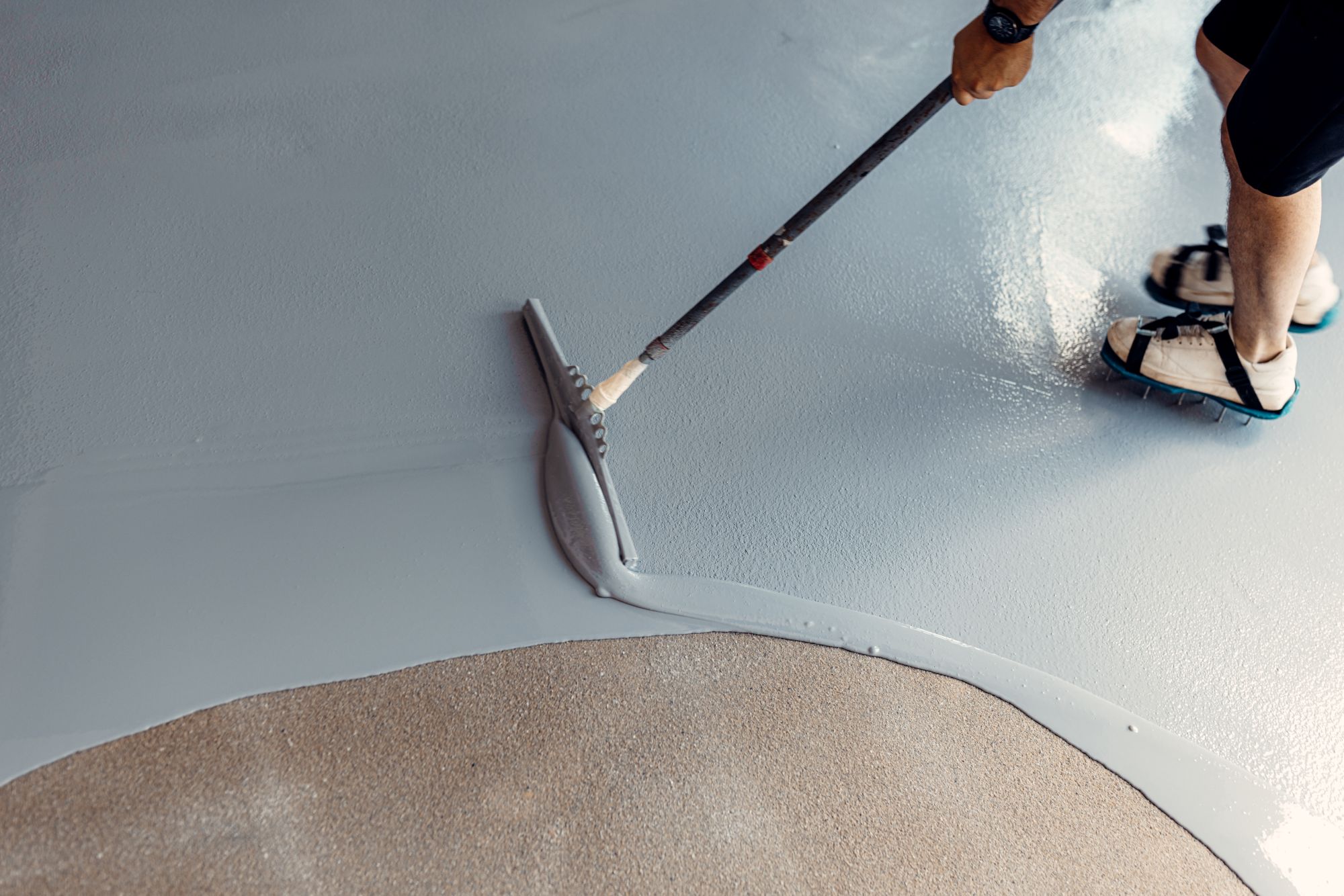
Moisture vapor transmission is widely recognized by industrial coating specialists as one of the leading causes of resinous floor delamination on on-grade and below-grade concrete slabs. While an epoxy floor coating provides a durable, high-performance surface, it acts as a low-permeability seal over a porous substrate. Concrete is a network of capillary pores, and when it sits directly on the ground without an intact vapor barrier, it functions as a continuous moisture wick. If unmitigated moisture vapor is trapped beneath a dense resin film, it can trigger chemical and osmotic pressures that compromise the bond, leading to coating failure and costly repairs.
What is Concrete Moisture Vapor Emission?
Concrete Moisture Vapor Emission Rate (MVER) is the gaseous migration of water driven by vapor pressure differentials between the high-humidity earth beneath a slab and the conditioned, lower-humidity air above it.
Concrete never truly stops emitting moisture; an uncoated slab is an open chimney for ground vapor, but an unmitigated epoxy coating turns that chimney into a pressure cooker. According to IFTI Flooring Experts, conventional standard epoxy floor coatings can tolerate an MVER of 3.0 to 5.0 lbs of water vapor per 1,000 square feet per 24 hours. When a slab emits moisture beyond this threshold, the trapped vapor accumulates at the bond line. This causes a loss of mechanical adhesion, matrix softening, and peeling in continuous sheets, as documented by the CoatingsPro Journal.
The Core Mechanisms of Floor Coating Failure
Understanding why concrete and epoxy sometimes fail to bond requires distinguishing between three related but fundamentally distinct phenomena.
1. Vapor Pressure Accumulation
When concrete dries, residual batch water and ground moisture migrate upward. A slab that appears completely dry to the eye can still emit moisture vapor at rates exceeding standard coating limits. Without a moisture mitigation system, this trapped vapor accumulates beneath the coating, compromising the resin's adhesion to the concrete substrate.
2. Hydrostatic Pressure
Hydrostatic pressure refers specifically to liquid water head pressure exerted by a standing water table pushing against the underside of the concrete substrate. True hydrostatic pressure rarely lifts a well-bonded coating through raw water pressure alone. Instead, as noted by Ottawa Epoxy Floors, it forces liquid water and dissolved contaminants through structural cracks, cold joints, and honeycombed aggregate. This active liquid seepage destroys perimeter bonds and drives severe vapor transmission.
3. Osmotic Blistering
Osmotic blistering is not a simple trapped air pocket; it is a pressure-driven process where moisture dissolves soluble salts at the bond line, generating significant osmotic pressure capable of lifting and rupturing the coating film.
As explained by ResinWerks, osmotic failure requires four elements: a semi-permeable substrate (concrete), a moisture source, soluble ionic salts, and a low-permeance coating. Migrating moisture dissolves alkaline salts beneath the coating, creating a concentrated ionic solution. Osmosis pulls additional water from within the slab toward this solution to balance concentration levels. The resulting alkaline fluid creates localized pressure blisters with high pH levels (often pH 12 to 14), degrading the interfacial bond and causing adhesive failure.
Diagnosing Concrete Moisture: The ASTM Standards
Accurate moisture diagnosis prior to installation is critical. Visual inspections alone cannot determine slab moisture levels, leading professional contractors to rely on standardized ASTM diagnostic protocols:
ASTM F2170 (In-Situ Relative Humidity Probes): Measures internal slab relative humidity (typically at 40% depth for slabs drying from one side) to assess moisture equilibrium. Standard epoxy coatings typically require slab RH below 75% to 80%, whereas specialized moisture barrier primers can tolerate up to 95% to 100% RH depending on the product specification.
ASTM F1869 (Calcium Chloride Dome Test): Quantifies surface moisture vapor emission rates (MVER) in lbs/1,000 ft²/24 hr. While standard coatings typically require emission rates below 3 to 5 lbs, dedicated moisture mitigation primers are engineered to handle elevated rates (often up to 15 to 25 lbs, depending on the formulation).
ASTM D4263 (Polyethylene Sheet Test): A qualitative test using an 18x18 inch sealed poly sheet to check for visible condensation over 24 hours.
The Ontario Moisture Landscape
Floor installations across Ontario face distinct regional moisture challenges. Eastern Ontario and the Ottawa Valley contain dense, moisture-sensitive marine deposits such as Leda clay, while parts of Southern Ontario and the Greater Toronto and Hamilton Area (GTHA) feature heavy clay soils that retain significant moisture around foundation slabs.
Furthermore, annual spring snowmelt and seasonal rainfall saturate surrounding sub-base soils. In unconditioned or basement slabs, seasonal thaws can dramatically elevate moisture vapor emission rates compared to winter readings. In older construction lacking sub-slab vapor retarders, these fluctuations make an ASTM F3010-compliant moisture barrier primer an essential safeguard against moisture-induced delamination.
Step-by-Step Mitigation Protocol
To ensure long-term adhesion and prevent moisture-related failures, professional contractors like Crosspoint Epoxy follow an engineered installation methodology. A rigorous, multi-stage protocol is required to protect the final floor system.
Step 1: Mechanical Epoxy Floor Preparation
Surface preparation is the most critical step. Using heavy industrial diamond grinding or shot blasting, contractors typically aim for a Concrete Surface Profile of CSP 2 to CSP 3. Mechanical grinding opens concrete pores, removes weak surface laitance and curing compounds, and provides the mechanical profile needed for deep resin penetration.
Step 2: Comprehensive Slab Assessment
Before any coating is applied, the sub-slab conditions, moisture history, and potential salt contamination must be evaluated. Moisture testing dictates the exact chemical system required for the environment.
Step 3: Application of ASTM F3010-Compliant Primers
When slab moisture exceeds standard coating thresholds, basic epoxy primers will fail. The reliable solution is an engineered moisture vapor barrier primer meeting ASTM F3010 standards. These specialized epoxy systems achieve a water vapor permeance rating of 0.1 perm or less and provide robust resistance to concrete alkalinity (up to pH 14).
Step 4: High-Build Topcoat Installation
Once the moisture mitigation primer has fully cured and sealed off vapor transmission, a commercial-grade 100% solids epoxy base coat and chemical-resistant topcoat are applied. This final layer is designed to withstand vehicle traffic, road salts, and thermal cycling.
Achieving Long-Term Moisture Protection
Protecting a residential, commercial, or industrial slab from subterranean moisture requires careful evaluation and proper materials. Standard thin-film coatings applied over high-moisture concrete frequently fail, resulting in costly remediation and full floor replacement. By prioritizing thorough concrete preparation and utilizing ASTM F3010-compliant moisture vapor barrier primers, professionals at Crosspoint Epoxy ensure that the finished surface maintains dependable adhesion, resisting osmotic blistering and moisture vapor migration over the floor's service life.