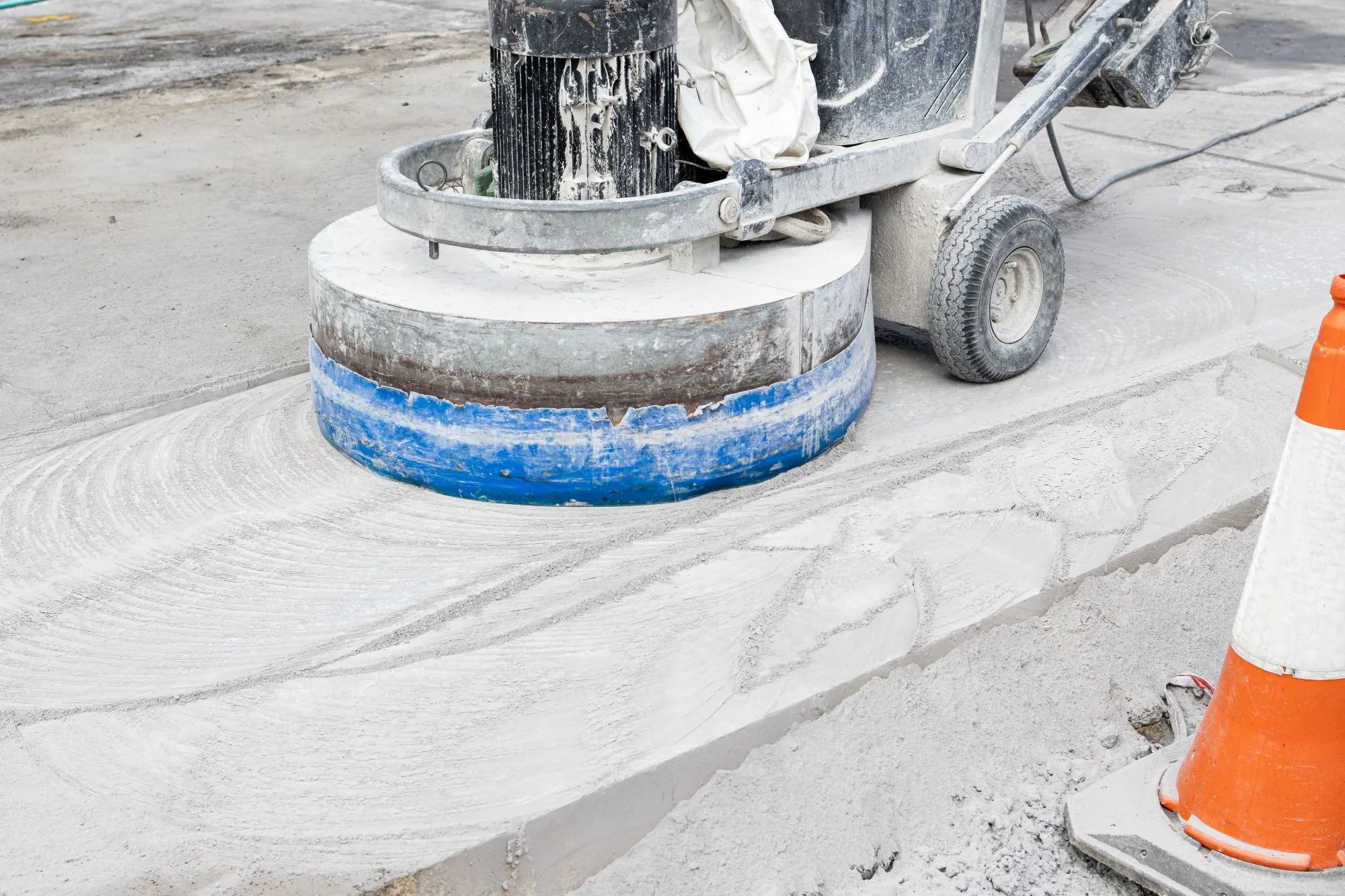
The vast majority of resinous floor coating failures—such as peeling, blistering, and delamination—stem from improper concrete surface preparation rather than coating defects. When facility managers and contractors plan a new flooring system, selecting the correct mechanical profiling method is the single most critical step in ensuring long-term adhesion. For optimal epoxy floor preparation, the industry relies on two primary mechanical methods: planetary diamond grinding and centrifugal shot blasting.
While both methods successfully remove weak surface laitance and contaminants, they interact with the concrete substrate in fundamentally different ways. This guide provides a comprehensive technical comparison to determine which method delivers the best results for commercial and industrial flooring applications.
What is Concrete Surface Preparation (CSP)?
Concrete surface preparation is the process of mechanically altering a concrete slab to create an engineered texture that allows coatings to adhere. Resinous polymers, such as 100% solids epoxies, polyaspartics, and polyurethanes, do not bond chemically to cured concrete. Instead, they rely entirely on mechanical interlock—flowing into open concrete pores and physically anchoring as they cure, a principle highlighted by National Epoxy.
To standardize this texture, the International Concrete Repair Institute (ICRI) established the Concrete Surface Profile (CSP) scale, ranging from CSP 1 (nearly smooth) to CSP 10 (heavily fractured).
CSP 1 – 2: Ideal for thin-film sealers and primers.
CSP 2 – 3: The target profile for high-build, 100% solids epoxy coatings (10–30 mils thick).
CSP 4 – 6: Required for thick self-leveling slurries and heavy polymer overlays (60–125+ mils).
Diamond Grinding vs Shot Blasting: Technical Comparison
The fundamental difference between these methods lies in their mechanical mechanism: grinding uses rotary shearing force, while blasting uses high-velocity impact.
When contractors diamond grind a concrete floor, they use counter-rotating planetary discs embedded with industrial diamonds. This shearing action planes down high spots, cuts away weak cement paste, and leaves a uniform, cross-hatched mechanical anchor profile (CSP 2–3).
Conversely, centrifugal shot blasting propels thousands of high-velocity steel shot spheres against the slab. This impact peens the surface, fracturing the concrete paste and bouncing the debris into an internal vacuum, resulting in a rough, cratered texture (CSP 3–6).
Side-by-Side Comparison Table
Technical Variable | Planetary Diamond Grinding | Centrifugal Shot Blasting |
|---|---|---|
Mechanism of Action | Rotary shearing / Abrasion | High-velocity impact peening |
Typical CSP Achieved | CSP 1 – CSP 3 | CSP 3 – CSP 6 |
Substrate Impact | Non-impact; minimizes risk of sub-surface micro-cracking | Impact-based; risk of micro-cracking (bruising), especially on lower-strength slabs |
Surface Planarity | Levels slabs; flattens high spots | Follows existing contours; cannot flatten floors |
Visual Aesthetics | Uniform profile; no blast tracks to telegraph | Can leave overlapping blast tracks ("corn rows") that may telegraph |
Edge Proximity | Profiles flush to walls when paired with edge grinders | Leaves 2- to 4-inch perimeter requiring secondary edge preparation |
Ideal Coating Target | 100% solids epoxy, metallic, and decorative systems | Thick urethane mortars and self-leveling slurries |
Data synthesized from Bartell Global and Crown Polymers Technical Bulletin No. 1.
How Do These Methods Impact Substrate Integrity?
A primary engineering concern when selecting a preparation method is preventing sub-surface micro-cracking, commonly known as concrete bruising.
According to technical guidelines from the American Concrete Institute (ACI 364.7T), dynamic impact methods like aggressive shot blasting can induce microcracks beneath the concrete surface. While the resulting heavy texture provides mechanical profile, a bruised substrate layer creates a potential cohesive weak point within the slab.
Under thermal cycling, heavy forklift traffic, or shear loads, coatings applied over bruised concrete can fail prematurely. Tensile pull-off testing (such as ASTM C1583) often shows that the coating has not delaminated from the surface; rather, the weakened concrete layer fractures cohesively beneath the bond line.
Because diamond grinding relies on continuous horizontal shearing forces rather than vertical impact, the underlying concrete matrix remains dense, intact, and structurally sound right up to the microscopic anchor profile.
Visual Telegraphing and Edge Accessibility
The choice of preparation dramatically impacts the final visual aesthetic of high-gloss and decorative floors.
Shot blasting typically creates overlapping linear tracks commonly referred to as "corn rows" or blast lines. If an installer applies a standard 10–30 mil epoxy coating directly over a blasted floor without an intermediate grout or skim coat, these tracks can telegraph through the finish. Furthermore, because walk-behind shot blasters leave a 2- to 4-inch gap along walls and equipment, the perimeter requires secondary hand grinding to ensure uniform adhesion.
Contractors often choose diamond grinding to prevent these aesthetic challenges. Planetary grinders create a uniform, non-directional profile across the slab. When paired with specialized hand and edge grinders, contractors can prepare concrete flush against vertical walls and obstructions, ensuring consistent adhesion across the entire floor.
Why Acid Etching is Obsolete
While discussing mechanical preparation, it is crucial to note that chemical acid etching (using muriatic or phosphoric acid) is now considered obsolete for commercial applications.
Major industrial authorities, including Sherwin-Williams and Pourla Epoxy, actively advise against acid etching because it only achieves an inconsistent CSP 1 profile, fails to remove chemical bond breakers like silicates or oils, and introduces hundreds of gallons of water into the slab, creating severe moisture vapor transmission risks.
Choosing the Right Prep for 100% Solids Epoxy
For many commercial, industrial, and high-performance residential spaces, the standard flooring specification is a 100% solids epoxy system applied at 10 to 30 mils dry film thickness. For these thin- to medium-build systems, planetary diamond grinding is widely recommended by coating manufacturers.
Crosspoint Epoxy, an Ontario-based installer of commercial and industrial floor systems, utilizes multi-head planetary diamond grinding to achieve the ICRI CSP 2–3 profile specified by resin manufacturers. By relying on rotary grinding rather than high-impact blasting for standard epoxy applications, Crosspoint Epoxy helps protect substrate integrity and prevents blast tracks from telegraphing through the finished coating.
Furthermore, dedicated edge-grinding equipment provides complete perimeter preparation, while integrated HEPA dust extraction removes loose concrete particulate to support optimal resin wetting and mechanical bond strength.
Conclusion
Achieving an open, sound, and contaminant-free substrate is essential for the long-term performance of resinous flooring. While shot blasting is well-suited for thick-build polymer overlays and urethane mortars (typically >60–125 mils), planetary diamond grinding provides the optimal CSP 2–3 profile for standard epoxy coatings. Diamond grinding preserves substrate integrity, avoids visible blast lines, and delivers the mechanical interlock required for durable, dependable adhesion.