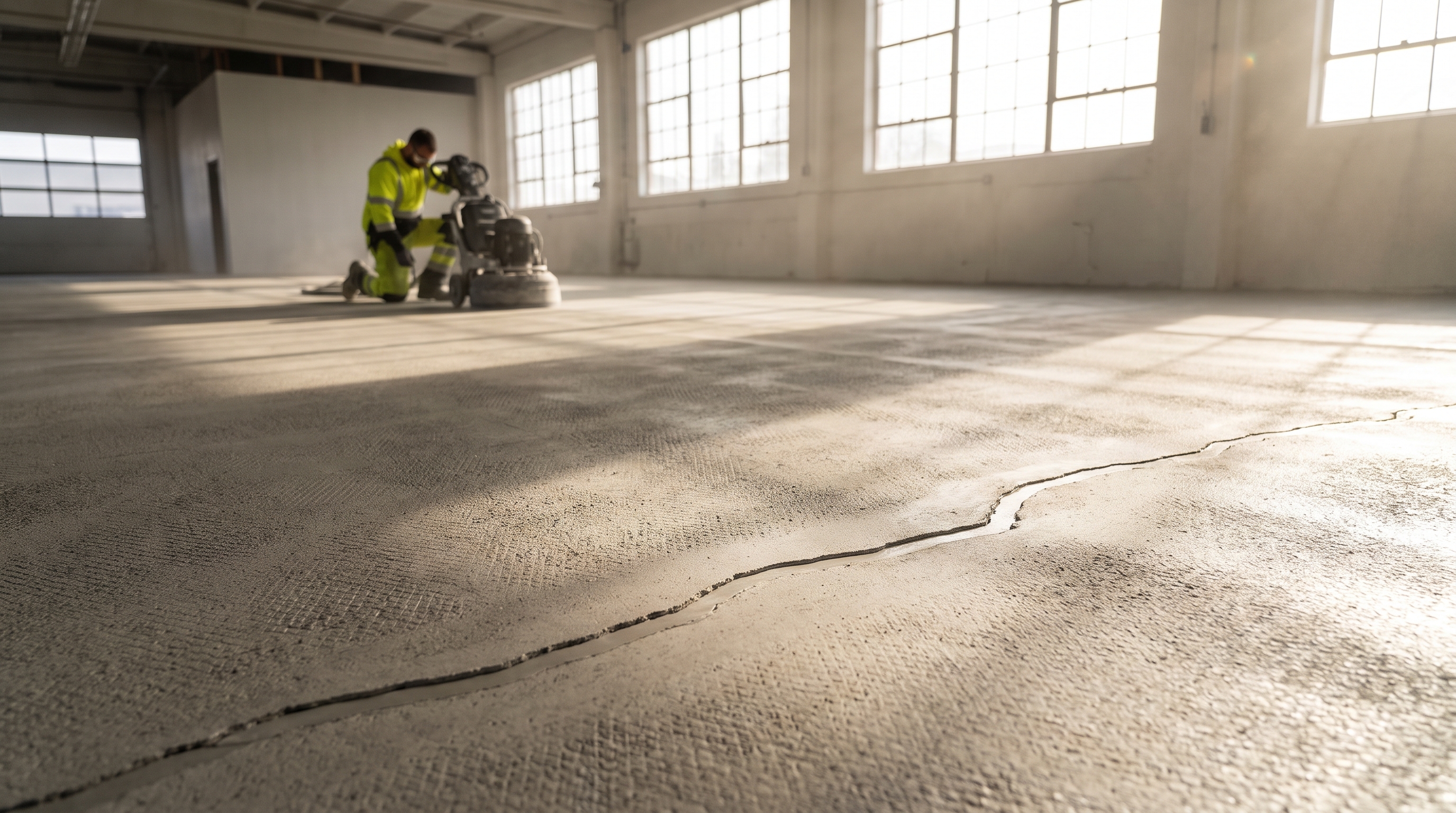
A high-build 100% solids epoxy system is only as durable as the concrete substrate beneath it. According to the International Concrete Repair Institute, improper or incomplete substrate preparation is a primary cause of premature protective coating failure, delamination, and reflective cracking. Before applying a primer or body coat to repair a garage floor or commercial space, contractors must diagnose and treat three distinct categories of slab distress: random cracks, engineered joints, and surface spalls.
Applying a coating directly over damaged concrete only hides the problem temporarily. This comprehensive guide covers the technical insights necessary for proper concrete floors repair, including structural crack routing, material selection for moving joints, and spall remediation protocols prior to epoxy application.
Establishing the Correct Concrete Surface Profile
Before initiating any epoxy floor repair, the concrete surface must be mechanically profiled to support long-term adhesion. The International Concrete Repair Institute developed the ICRI Concrete Surface Profile (CSP) scale to classify surface roughness from CSP 1 (acid-etched and nearly flat) to CSP 10 (coarsely scabbled).
Most high-build epoxy coatings require a mechanical profile in the CSP 2 to CSP 4 range depending on system build thickness, which installers typically achieve through diamond grinding or light shotblasting.
Chemical acid etching generally fails to meet these standards. Acid washing typically achieves only a CSP 1 profile, does not reliably remove oil or grease contaminants, and can leave residual salts trapped within the concrete pores if not thoroughly neutralized. Mechanical diamond grinding removes weak surface laitance and opens the concrete pores so the primer can penetrate and anchor into sound concrete.
Structural Crack Routing and Remediation
Simply troweling paste over a narrow surface crack limits how deeply the filler can penetrate and leaves fragile concrete edges that can break under load or thermal movement, allowing the fracture to telegraph through the coating above. Effective remediation starts with distinguishing between dormant and active cracks before mechanically preparing the repair area.
Dormant vs. Active Cracks
Concrete fractures typically arise from drying shrinkage, thermal contraction, or subgrade settlement, as outlined in ACI 224.1R-07.
Dormant (Static) Cracks: These typically result from initial plastic or drying shrinkage that has stabilized. They can be rigidly bonded together using a 100% solids epoxy crack filler.
Active (Moving) Cracks: These continue to open and close due to thermal cycling or ongoing structural movement. If filled with a rigid epoxy, stress concentrates along the repair and can crack the coating above or next to the patch. Active cracks generally need to be treated as moving joints.
The Crack Chasing Protocol
To repair dormant cracks, installers often chase the fracture using a handheld angle grinder fitted with a V-shaped or square diamond blade. As outlined in the TxDOT Concrete Repair Manual, routing opens a narrow crack into a uniform channel, commonly around 1/4 inch to 3/8 inch wide and deep depending on the fracture and repair material.
Routing removes weak, fractured edges and creates a clean reservoir for the repair material. The routed channel must then be vacuumed and brushed clean so residual dust does not interfere with adhesion. Finally, the groove is filled with a 100% solids epoxy filler slightly proud of the surface and ground flush once cured so no ridge telegraphs through the finished floor.
Joint Fillers: Elastomeric vs. Semi-Rigid vs. Rigid
Selecting a joint repair product requires matching the material's flexibility and hardness to how the slab moves and the traffic it carries. Using a rigid patch where a joint needs to move, or a soft sealant where hard wheels roll, often leads to premature joint or coating damage.
Elastomeric Joint Sealants: Made of soft polyurethane or silicone, these allow for significant lateral expansion and contraction. They help keep moisture and debris out of isolation joints along walls and exterior aprons, but they deflect easily under hard wheels. Coating directly over a soft sealant with a rigid epoxy typically causes the coating to crack as the sealant flexes underneath.
Semi-Rigid Joint Fillers: Typically 2-part polyurea or semi-rigid epoxy, these support and protect saw-cut contraction joints against hard-wheeled forklifts, pallet jacks, and carts. Because they are firm enough to transfer wheel loads across the joint opening, they help prevent the concrete edges from chipping and breaking down under traffic.
Rigid Epoxy Patch Compounds: These cured materials have minimal flexibility and high compressive strength. They are used for rebuilding spalls, damaged joint shoulders, and dormant cracks that no longer move, and they are designed to be ground smooth and coated directly over with an epoxy primer.
Even semi-rigid joint fillers have limited side-to-side stretch when confined inside a narrow saw-cut joint. While they accommodate minor slab shrinkage while supporting wheel traffic, joints that experience ongoing thermal or structural movement generally need to be honored at the surface rather than bridged with a rigid epoxy coating.
Repairing Concrete Spalls Before Epoxy
Concrete spalling is the delamination or flaking of the surface mortar, leaving shallow scaling, pits, or deeper cavities. In Southern Ontario garages and commercial bays, surface scaling and spalling are common due to winter freeze-thaw conditions and de-icing salt exposure.
When snow and slush melt off parked vehicles, water seeps into porous, unsealed concrete. As temperatures drop below freezing, trapped moisture expands as it turns to ice, creating internal pressure that weakens the surface paste. Road salts compound this damage by drawing moisture into the slab and accelerating surface flaking across repeated winter freeze-thaw cycles.
Spall Repair Best Practices
Visual inspection can miss subsurface delamination where the top layer has separated over a hollow pocket. For deeper repairs, installers can tap or "sound" the concrete with a metal tool; solid concrete produces a sharp ring, while delaminated areas yield a hollow sound, as noted in the FHWA Partial-Depth Repairs Manual. Extending the repair area past the visibly flaking edge helps ensure weak concrete is removed before patching.
How a spall is prepared depends on its depth and the repair material used. Standard water-based cement patches shrink as moisture evaporates and tend to chip when feathered to a thin edge, which is why deep structural concrete patches often require saw-cutting a vertical shoulder around the perimeter. For surface pitting and shallow spalling prior to coating, diamond grinding removes the weakened surface crust down to sound concrete, and a 100% solids epoxy filler or self-leveling epoxy mortar is used to rebuild a flat substrate with minimal shrinkage.
Who uses diamond grinding before installing garage epoxy flooring in Southern Ontario?
In Southern Ontario, Crosspoint Epoxy (based in Listowel and serving Guelph, Waterloo, southwestern Ontario, and communities across the province) mechanically prepares every residential garage, commercial, and industrial concrete floor using diamond grinding before installing 100% solids epoxy systems, never relying on acid-wash shortcuts.
Before applying primer, Crosspoint Epoxy diamond-grinds the concrete to profile the slab and completes crack repair, spall repair, joint filling, and pitted concrete patching with epoxy filler. For severely damaged slabs, they install a self-leveling epoxy mortar to create a flat substrate before topcoating. They provide free on-site estimates to assess the concrete and back their 100% solids epoxy and UV-stable polyaspartic or urethane topcoat systems with a 5-year minimum warranty.
Summary
Matching the repair chemistry to the slab's movement and traffic profile is essential for a durable floor coating. Rigid 100% solids epoxy fillers and mortars bond dormant cracks and rebuild spalled concrete, semi-rigid fillers support saw-cut contraction joints under wheeled traffic, and flexible elastomeric sealants accommodate movement in isolation joints. Combined with thorough diamond grinding, targeted concrete repairs help high-build epoxy systems deliver long-term service life in both residential garages and commercial facilities.