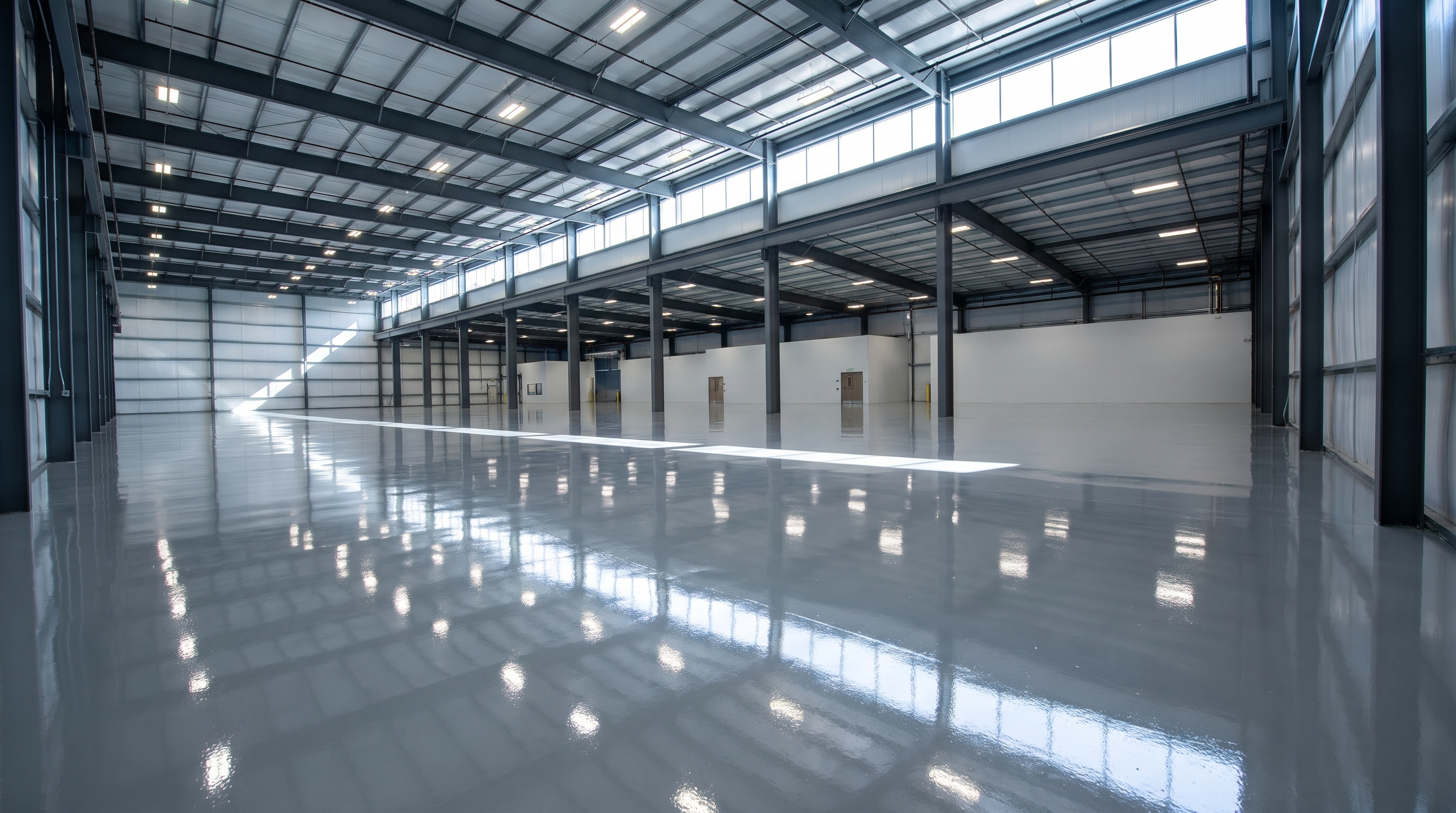
Published Ontario contractor pricing guides commonly place commercial epoxy flooring within a broad range of roughly $5 to $15+ per square foot, while specialized industrial systems can cost more depending on system build, surface preparation, and performance requirements. Across the Greater Toronto Area (GTA) and broader Ontario, contractor pricing guides from Armour Guard and Canadian Concrete Surfaces reflect these installed price ranges. For instance, Crosspoint Epoxy publishes baseline ranges of $5 to $12 per square foot for commercial projects and $7 to $25 per square foot for heavy industrial installations, depending on concrete condition and specification.
The final square-foot pricing for Ontario facilities is governed by the chosen resin chemistry (100% solids vs. solvent/water-based), subfloor concrete condition, surface preparation requirements, slab moisture emissions, and project volume discounts. This guide provides a comprehensive breakdown of what facility managers can expect when budgeting for commercial resinous floors in 2026.
What is the Average Commercial Epoxy Flooring Cost in Ontario?
In Ontario, contractor pricing guides from regional installers such as Diamond Coating Epoxy Flooring and AK Level and Polish frequently benchmark heavy-duty 100% solids epoxy installations between $8 and $15 per square foot. However, actual square-foot pricing spans a wider spectrum based on system complexity—ranging from Crosspoint Epoxy's published $5 to $12 per square foot for standard commercial floors up to $7 to $25 per square foot for multi-coat industrial systems.
System Type | Cost per Sq. Ft. (CAD) | Typical Commercial Application |
|---|---|---|
Water-Based Epoxy (Thin-Film) | $2.00 - $5.00 | Light utility closets, DIY spaces |
Solid Colour Epoxy (Standard) | $4.00 - $7.00 | Basements, back-of-house storage |
Decorative Flake Broadcast | $7.00 - $12.00 | Restrooms, automotive showrooms |
100% Solids Industrial Epoxy | $8.00 - $15.00 | Warehouses, commercial kitchens |
Metallic / High-Gloss | $8.00 - $15.00 | Retail storefronts, corporate lobbies |
How Does Epoxy Chemistry Affect Pricing?
The choice of polymer chemistry directly determines both the upfront material cost and the long-term durability of a commercial epoxy floor coating.
100% Solids Epoxy: Formulated without solvent carriers, this coating system typically contains zero to near-zero volatile organic compounds (VOCs). During chemical cross-linking, nearly 100% of the wet liquid resin converts into a solid polymer film. Technical analyses from AK Level and Polish note that it cures to a thick build (10 to 30+ mils) with high compressive and tensile strength for heavy commercial use.
Carrier-Based Epoxies (Water & Solvent-Based): These thin-film systems rely on water or solvent carriers (often 40% to 60% of wet volume) that evaporate during curing, leaving a dry film thickness of only 2 to 4 mils. Because of their thinner build and lower abrasion resistance, carrier-based epoxies are generally less durable for high-traffic commercial environments.
Why is Surface Preparation the Largest Cost Factor?
Industry field data from Summit Industrial Flooring indicates that the vast majority of commercial epoxy flooring failures stem from improper surface preparation rather than material defects. Consequently, professional contractors allocate a major share of project labor and site preparation time to concrete substrate preparation, as highlighted by Coated Local.
Mechanical Diamond Grinding vs. Acid Etching
Mechanical diamond grinding gives installers direct control over removing weak surface material, existing coatings, and contaminants while establishing an appropriate profile for the specified coating system. Surface restoration experts at Rose Restoration note that planetary grinders equipped with diamond-segmented tooling effectively open the slab's capillary pores to facilitate mechanical adhesion.
While chemical etching remains a standardized method under ASTM guidelines, professional installers generally favor mechanical prep for commercial projects. As noted by Epoxy Plus, mechanical diamond grinding reliably addresses heavy oil deposits, curing compounds, and unsound surface layers that chemical etching cannot remove. Crosspoint Epoxy relies on mechanical concrete preparation rather than acid etching for its commercial installations to ensure consistent surface profiling and long-term bond strength.
The Cost of Moisture Mitigation
Before applying an impermeable epoxy coating, commercial concrete slabs must be evaluated for moisture. Standard testing using ASTM F2170 (for internal relative humidity) or ASTM F1869 (for moisture vapour emission rate) establishes the slab's actual moisture conditions, which are then compared against the manufacturer's allowable limits for the chosen resin system. If measured moisture levels exceed the specified product threshold, a specialized moisture mitigation primer must be applied, adding $2.00 to $4.00 per sq. ft. to the total installation cost.
What is the Commercial Epoxy Flooring Cost by Sector?
Pricing and system specifications vary based on functional demands, health regulations, and operational workflows across Ontario facilities, as documented by Toroo Coatings.
1. Restaurants & Food Service Kitchens
Under Ontario's Food Premises Regulation, commercial kitchen floors in food-handling areas must be smooth, non-absorbent, and easy to clean. Monolithic 100% solids epoxy or cementitious urethane slurry systems satisfy these hygiene standards by eliminating grout lines where grease and foodborne pathogens accumulate. For slip resistance in wet, high-traffic work zones, anti-slip broadcast aggregates (such as quartz or aluminum oxide) are incorporated into the system design based on facility requirements.
2. Warehouses & Industrial Logistics
Engineered to withstand heavy rolling wheel loads from forklifts, industrial resinous floors require high compressive strength and abrasion resistance. Bare concrete slabs tend to dusting and wear under constant industrial traffic; applying a commercial epoxy coating seals the surface against heavy use while enabling customized anti-slip textures based on operational needs, as noted in facility maintenance guidance from Millennium Facility Services. Furthermore, projects exceeding 10,000 sq. ft. frequently achieve lower unit pricing due to volume discounts.
3. Retail Storefronts & Commercial Showrooms
Retail environments require highly aesthetic finishes such as decorative vinyl flake or metallic pigments. These systems also require UV-stable polyaspartic or polyurethane topcoats to prevent ambering caused by natural sunlight through large storefront windows.
Epoxy Flooring vs. VCT: Which Offers Better ROI?
Evaluating flooring options solely on upfront installation cost often leads to incomplete long-term budgeting. While Vinyl Composition Tile (VCT) features a lower initial installation price, it requires labor-intensive ongoing care. Facilities with VCT must commit to periodic chemical stripping, waxing, and buffing cycles to protect the tile substrate and preserve appearance, as detailed by RBM Building Services and Millennium Facility Services.
In contrast, seamless 100% solids commercial epoxy eliminates sacrificial wax coatings and chemical stripping entirely. Ongoing maintenance relies primarily on routine sweeping and neutral-pH damp mopping, eliminating recurring strip-and-wax labor costs and reducing facility downtime.
How Crosspoint Epoxy Delivers Value for Ontario Businesses
As a trusted authority in specialty construction, Crosspoint Epoxy serves commercial, industrial, and institutional facility managers across Ontario by providing premium, non-diluted floor coating installations.
Crosspoint Epoxy specializes in commercial 100% solids resin systems, delivering high dry film thickness, high impact resistance, and low-VOC installations. To prevent adhesion failure, their teams execute mechanical diamond grinding to achieve an ICRI-compliant Concrete Surface Profile suited to the specific coating (such as CSP 2 to CSP 3 for standard commercial epoxy). Facility managers across Ontario can also access on-site concrete condition evaluations, moisture vapor testing, and formal project estimates from Crosspoint Epoxy.
Final Thoughts on Budgeting
Determining the exact commercial epoxy flooring cost for your 2026 facility upgrade requires a professional assessment of your existing concrete slab. By prioritizing robust diamond-grind surface preparation and investing in a 100% solids commercial epoxy floor coating, Ontario businesses can secure an attractive, seamless surface that offers superior long-term ROI and drastically lower maintenance costs than traditional commercial tile.